Mining Payout Records: Keeping Books That Survive an Audit
A 1 PH/s fleet paid hourly under PPS+ generates 24 ledger lines a day and about 720 in a 30-day month, worth roughly 0.014206 BTC — near $1,211.68 of gross block-reward income at a BTC price of $85,294. Books that survive an audit are built around that cadence from the first week, not reassembled in December from screenshots of a dashboard.

Key takeaways
- Cadence first: PPS+ settles at current difficulty every hour, while PPLNS pays after 6 confirmations using your share of the last 5 difficulty rounds — roughly a 70-day window at 2,016 blocks per round.
- Keep the fee components apart: the listed 4% applies to the PPS-settled block reward, the listed 2% applies to transaction fees, and PPLNS applies a listed 2% to both together.
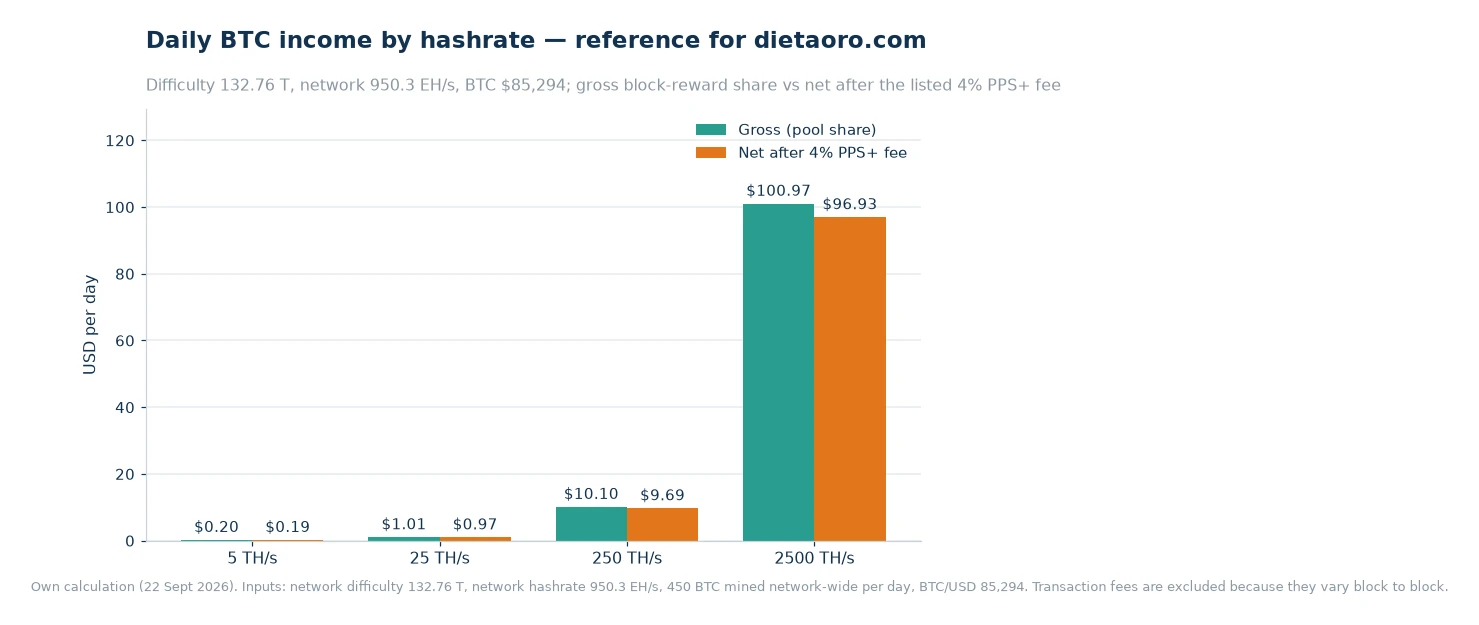
- Gross and net are different totals. At 2.5 PH/s a month, that gap is around $121, and it has to be visible on its own line rather than netted away.
- Extra asset lines are normal: DOGE from merged mining and any Auto Conversion trades each need a timestamp and a value.
What has to be in the row
Every settlement entry needs the same seven fields, whatever the coin: the time it covers, the asset, the settlement basis, the gross amount, the fee component applied, the net amount and where the funds landed. Without those, a line cannot be checked against the platform's own statement, which is the first thing any reviewer asks for.
The supporting context matters as much as the row itself. Income is a proportion of network output, so a record that does not carry the network difficulty in force cannot be recomputed later. Difficulty changes at least every 2,016 blocks, which means the same hashrate legitimately produces different totals in different weeks. A book that stores a single monthly average hides exactly the evidence that makes the numbers verifiable.
Keep the pool-level figures alongside the payout lines while you are at it. Network difficulty, network hashrate and your own effective hashrate are what turn a payout into an explainable number, and they cost nothing to store at the moment you read them.
Two settlement cadences, two shapes of ledger
PPS+ produces a steady stream. Because it settles every hour at current difficulty, the entries are small and predictable, and the miner carries neither pool luck nor orphan risk on the block-reward component — which is why the listed fee on that component is 4%. For bookkeeping, that is the easy case: the arithmetic can be checked line by line, and each line is small enough that a mistake shows up immediately as a rounding anomaly.
PPLNS produces clusters. Payments appear when blocks collect 6 confirmations, sized by your share of pool hashrate over the last 5 difficulty rounds. In the books that pattern looks like nothing for a while and then several entries together. If the record does not name the window and the round boundaries, a quiet fortnight is indistinguishable from a breakdown.
| Field | Example value | The question it answers |
|---|---|---|
| Settlement time | Hourly under PPS+, so 24 entries a day | Does the total match the platform statement for that day? |
| Gross amount | About 0.00001973 BTC an hour, near $1.68 | Does hashrate multiplied by network output produce it? |
| Fee basis named | Listed 4% on the PPS-settled block reward | Which component was charged, and at what listed rate? |
| Net amount | Roughly 0.00001894 BTC an hour at 1 PH/s | Is the difference between gross and net fully explained? |
| Asset lines | DOGE from merged mining, plus converted balances | Does each asset carry its own value and date? |
| Destination | Withdrawal to an exchange or self-custody address | Where did the balance go after accrual? |
Worked example
Take a 2.5 PH/s fleet over a 30-day month, block-reward income only. Step one, daily gross: 2,500 TH/s multiplied by 0.0000004735 BTC per TH/s per day gives 0.00118375 BTC, which is about $100.97 at $85,294. Step two, the month: 30 times that amount is roughly 0.0355125 BTC, or $3,029.10.
Step three, the fee line. The listed 4% applies to the PPS-settled block reward, so about $121 of the month is fee and about $2,907.90 is net. Written across 720 hourly settlements, the gross figure per entry is close to $4.21 and the fee per entry close to $0.17. Those two columns should reconcile to the monthly statement without a plug figure.
Step four, the comparison that people forget. Had the same fleet been on PPLNS, the listed rate would be 2% on both components together, and the shape of the ledger would change from 720 even entries to a handful of block-linked ones. At 1 PH/s the spread between a 4% and a 2% charge on the block-reward component alone is $24.23 for a month, which is small enough to be lost in a sloppy ledger and large enough to matter in the totals.
Where mining records break
The most common failure is recording only the cash that arrives. Accrual is what the mining produced; cash is what moved. A fleet on PPLNS can accrue for weeks before a payment lands, and a fleet on PPS+ accrues hourly whether or not anything is withdrawn. Netting the two together makes the month look smoother than it was and destroys the ability to match a payout to the blocks behind it.
The second is dropping the difficulty. When difficulty moves, the same hardware produces a different amount, and a record that omits the difficulty cannot distinguish a rate change from an equipment change. The third is losing merged-mining output in the noise: DOGE produced on top of the LTC reward is a second asset with its own value and its own line, not an adjustment to the LTC figure.
The fourth is a conversion with no recorded rate. An Auto Conversion trade needs the assets on both sides, the amount, the time and the change in balances, because the converted balance has a different basis from the mined one. The fifth is treating a zero-fee mining withdrawal as a non-event: the fee is nil, but the transfer still leaves the account and still needs a destination recorded.
Read the fee schedule next to a ViaBTC Mining Guide once, before the first payout rather than after the first disagreement. It also helps to keep the wallet side of the account tidy while the numbers are small: holding mined balances in the same multi-currency wallet that receives them removes a reconciliation step, and any Collateral-Pledged Loans taken against equipment should sit in a liability column rather than being netted against mining income.
Frequently asked questions
Does a zero-fee payout still need to be entered in the books?
Yes. Zero-fee mining withdrawals remove the fee line, not the transfer. The amount, the asset, the destination and the time belong in the record, because the balance leaves the account and the receiving side needs the same entry.
Why do PPLNS payouts arrive in bursts?
Because payout depends on blocks reaching 6 confirmations and on your share of pool hashrate across the last 5 difficulty rounds. Blocks do not arrive on a schedule, so several payments can land together after a quiet stretch.
Should converted balances be shown separately from mined balances?
Separately, with the rate used for the conversion. A converted coin has a different basis from the coin that was mined, and merging the two lines makes it impossible to explain the balance at any point in the month.
Build the ledger around the cadence
Decide the entry shape once, based on how the account is paid, and then keep it consistent. Hourly settlement means hourly rows with the difficulty of that day attached; block-based settlement means fewer rows, each one naming the confirmation and the window it was measured over. Add merged-mining outputs and conversions as their own lines, record destinations even when the transfer is free, and keep liability items out of income. Six months of that habit turns a tax question into a lookup rather than an archaeology project.
Fees cited: the ViaBTC listed schedule covering PPS+ and PPLNS[1]. Inputs used in the arithmetic were BTC difficulty 132.76 T, network output of 450 BTC a day and a BTC price of $85,294, read from public chain data and market feeds on 22 Sept 2026. All amounts are arithmetic on the stated inputs, and no amount here is a promise of earnings. read 22 Sept 2026.