A sourcing proposal is easier to evaluate when it separates the service fee, supplier quotation, inspection or project charges, and logistics assumptions. Buyers should confirm which activities are included, how fees are calculated, what triggers additional charges, who contracts with each supplier, and where transport and customs responsibilities sit. A low headline price is meaningful only when its scope and cost basis match the alternatives.
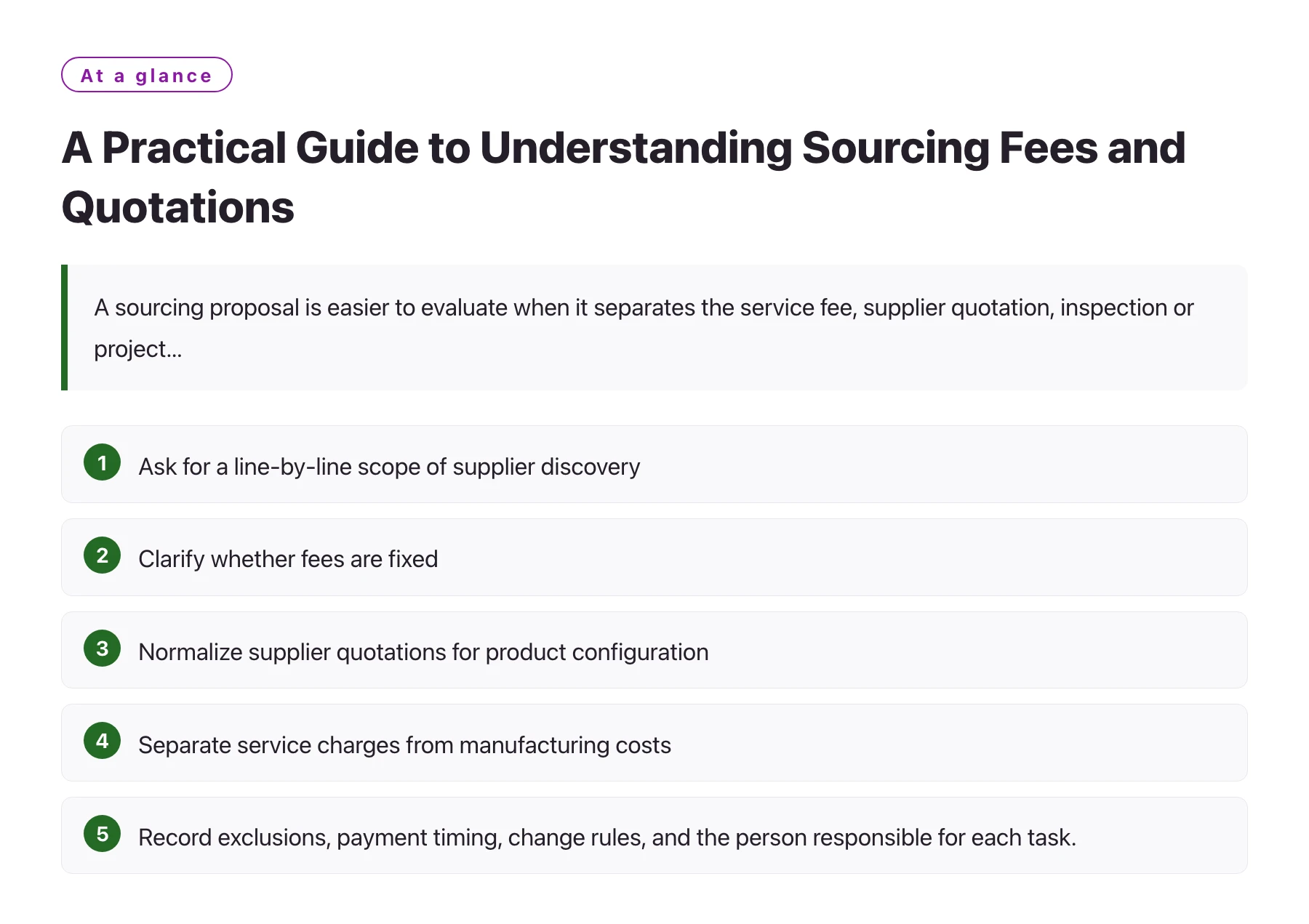
Key takeaways
- Ask for a line-by-line scope of supplier discovery, samples, coordination, inspection, and follow-up.
- Clarify whether fees are fixed, hourly, percentage-based, per order, or triggered by milestones.
- Normalize supplier quotations for product configuration, quantity, packaging, and delivery assumptions.
- Separate service charges from manufacturing costs, freight, insurance, duties, and destination fees.
- Record exclusions, payment timing, change rules, and the person responsible for each task.
Request a written comparison on a common product brief and delivery scenario before choosing a service model.
Separate the kinds of cost in the proposal
A sourcing engagement may include a professional service fee, supplier or factory charges, sample and tooling costs, testing or inspection fees, freight, insurance, customs-related charges, and destination handling. Ask the provider to show each category separately and state whether the quoted figure is an estimate, a fixed amount, or a pass-through cost. Do not compare a service fee that excludes inspections with a package that includes them as though they covered the same work.
For each charge, note currency, tax treatment if applicable, validity period, payment trigger, refundability, and supporting document. Ask who receives the payment and who is contractually responsible for the underlying work. Where the provider earns a commission, rebate, or other supplier-side compensation, request a clear explanation of how it is disclosed and whether it affects supplier recommendations.
Buyers assessing JS Sourcing or any other provider should link the quote to a written scope and order. The provider name alone does not describe which sourcing, quality, or logistics tasks are actually included.
Make the service scope concrete
Break the scope into stages such as supplier discovery, shortlist research, factory communication, sample coordination, specification clarification, purchase-order follow-up, production updates, inspection booking, shipment documentation, and issue escalation. For every stage, identify the deliverable, owner, expected timing, number of included revisions or suppliers, and information the buyer must provide. This prevents a general “sourcing support” label from creating different expectations on each side.
Ask what is excluded. Common areas to clarify include legal advice, regulatory classification, laboratory testing, independent inspection, travel, translation, tooling, sample freight, banking costs, customs brokerage, local taxes, rework, and emergency rescheduling. The exact exclusions depend on the contract. If the buyer expects a specific task, it should be named rather than inferred from an informal conversation.
Define when the engagement begins and ends. A project may close at supplier selection, order placement, shipment departure, delivery, or resolution of a defined issue. State what follow-up is available after delivery and whether it is covered by the original fee. If a quotation is based on a percentage of product value, clarify which costs count toward the calculation and how changes affect the fee.
Normalize supplier quotations before comparing them
Give each supplier the same product brief, revision, materials, configuration, quantity, color mix, quality requirements, packaging, delivery point, and requested date. Ask suppliers to show unit price, minimum order, tooling, samples, production packaging, spare parts, tests, inspection, payment terms, and quotation validity. List alternatives and exclusions separately so a lower number does not conceal a different product or service level.
Check whether each price is per unit, per set, per carton, or based on a specific batch. Confirm currency and exchange-rate assumptions, included accessories, replacement parts, labeling, and carton count. If the supplier uses a tiered price, note the quantity breakpoint and whether variants can be combined to reach it. Ask what happens if the final order quantity changes after sampling.
Record the proposed delivery term and named place. The U.S. International Trade Administration explains that Incoterms allocate tasks, costs, and risks between buyer and seller, including shipment, insurance, documentation, and customs responsibilities. Select and state the applicable rule and exact location in the contract, then separately model costs that remain outside that allocation. [1]
Map service charges to the work performed
If a provider charges a fixed project fee, ask what volume and duration it assumes, how many suppliers or product categories are included, and what counts as a scope change. If the fee is hourly or daily, clarify how time is recorded, approved, and billed. If it is commission-based, identify the calculation base, payment timing, minimums, and whether the buyer can verify the underlying supplier transaction.
Ask how expenses are approved. Sample courier charges, factory visits, translation, laboratory work, re-inspection, and storage can accumulate outside the product price. Set a threshold for advance approval and require receipts or a clear pass-through record. Decide who bears costs when a supplier’s error requires rework or another inspection, based on the contract and evidence.
For recurring purchases, distinguish ongoing account support from per-order work. Define what service remains available between orders and how new product development, supplier changes, urgent requests, or additional locations are priced. A simple fee schedule with examples is more useful than an open-ended promise to discuss costs later.
Build a landed-cost view without double counting
Prepare a cost worksheet that includes product value, service fees, samples, tooling, packaging, origin handling, international freight, insurance, customs brokerage, duties or taxes, destination handling, storage, and final delivery where applicable. The buyer’s customs broker or finance team should verify classifications and duty assumptions. Mark unknown amounts as estimates and give each estimate an owner and a date for confirmation.
Check which party arranges and pays for each logistics activity under the delivery term and service contract. Avoid adding a freight charge twice if it is already included in a supplier’s offer or forwarder quote. Conversely, do not assume a delivery term includes every destination fee or import obligation. Ask for the quote’s starting and ending points and what the price expressly excludes.
Use scenarios where freight, exchange rates, order quantity, or delivery timing are uncertain. Compare a base case and a plausible adverse case without presenting either as a guaranteed final cost. This shows which unknowns can change the decision and what information is needed before a purchase order is approved.
Review payment and commercial protections
Record deposit, progress payments, balance timing, service-fee milestones, bank charges, and the party receiving each payment. Check that invoice names and bank instructions match verified contractual parties. Any change to payment details should be confirmed through an established contact route rather than relying on a new email alone. The buyer’s finance team should review currency, tax, and accounting treatment.
Define cancellation, refund, delay, and dispute terms. Ask what happens if a supplier cannot meet the specification, a sample is rejected, production is delayed, or the provider’s scope changes. Identify whether supplier deposits, custom tooling, or shipped samples are recoverable. Clarify ownership of drawings, molds, samples, inspection reports, and supplier records created during the engagement.
Confirm confidentiality and conflict-of-interest expectations where product plans, pricing, or supplier relationships are sensitive. Identify who may contact the factory directly, who may share commercial data, and whether the buyer receives copies of quotations and inspection evidence. These operational rules reduce misunderstandings and keep decisions traceable.
Compare proposals with a decision table
Create columns for scope, deliverable, fee basis, included suppliers, sample handling, inspection, logistics coordination, exclusions, payment terms, change fees, and evidence provided. Add a row for each provider or service model. Mark each item as included, excluded, conditional, or unclear; request clarification before scoring. This makes non-price differences easy to see and gives the buyer a written basis for negotiation.
Apply priorities that matter to the project: product complexity, number of suppliers, internal staff capacity, schedule, quality risk, destination markets, and visibility of costs. Do not use a numerical ranking to hide unresolved regulatory, commercial, or quality questions. A candidate can be attractive on price while still requiring an unpriced inspection or unclear transport responsibility.
Keep the decision memo with the selected quote, approved assumptions, and open items. Revisit the comparison when quantity, product specification, delivery term, or project timing changes. A change to any of those inputs may invalidate the original cost comparison.
Confirm the agreement before work starts
Ask for an agreement or statement of work that names the parties, products, services, fee schedule, reimbursable expenses, payment dates, deliverables, timeframes, exclusions, confidentiality, change process, and termination rules. Attach the approved product brief or supplier quotation where it defines the scope. Make sure verbal promises that affected the decision appear in the written version.
Set a regular update cadence and escalation route. Specify what information will be shared after supplier responses, sample dispatch, production milestones, inspection, and shipment booking. Identify who approves spend, product changes, commercial concessions, and release decisions. A clear communication map is especially useful when several teams share responsibility.
After delivery, compare actual service, costs, timing, and issue handling with the proposal. Record which estimate differences came from scope changes, supplier variation, freight, or missing assumptions. Use that review to improve future requests for quotation and engagement terms rather than assuming the first quote will remain valid for every order.
Sources
Frequently asked questions
Is a percentage-based sourcing fee always cheaper than a fixed fee?
Not necessarily. Compare the fee base, included work, incentives, additional expenses, and order value under the same scope before assessing the total.
What should be included in a sourcing quotation?
It should identify deliverables, fee basis, included and excluded work, expenses, payment timing, assumptions, change rules, and which party is responsible for each task.
Do Incoterms tell me the complete landed cost?
No. They allocate specified buyer and seller tasks, costs, and risks. Taxes, duties, service fees, and other charges still need separate review.
How can I compare two quotes with different delivery terms?
Map each quote to the same named destination and cost categories, confirm who handles each transport and customs task, and get unresolved estimates verified by the responsible specialists.