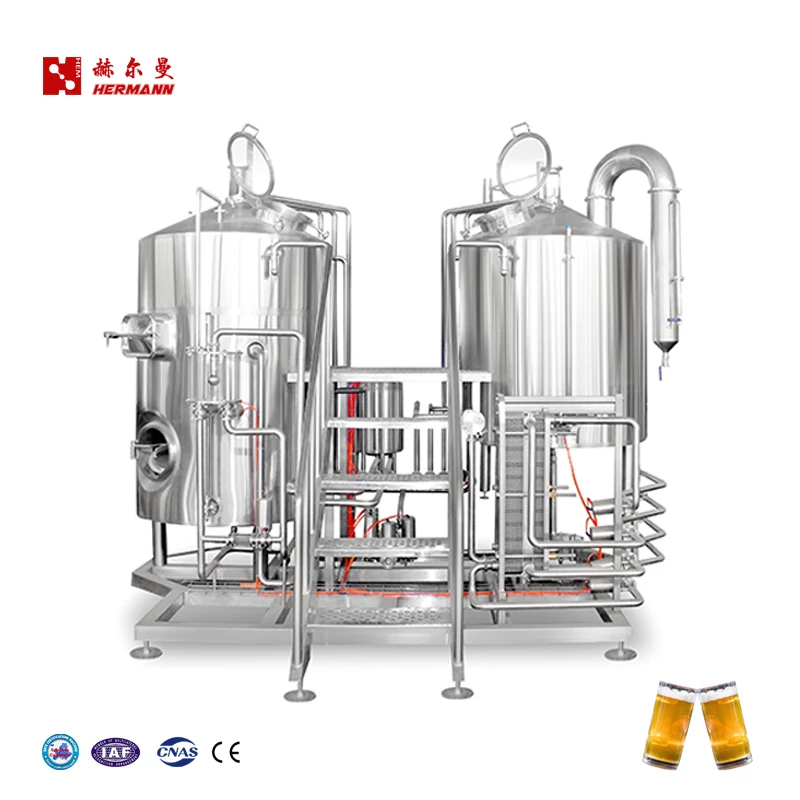
Stainless steel brewhouse systems are reliable because their material, fabrication, cleaning design, thermal control, and mechanical layout can be measured against established food-processing standards. Type 304 stainless commonly contains about 18% chromium and 8–10% nickel, while 316 grades add roughly 2–3% molybdenum for better resistance in chloride-rich conditions. Sanitary equipment commonly targets product-contact finishes of Ra 0.8 μm (32 μin) or smoother. Proper weld finishing, full drainage, correctly sized pumps, stable heating surfaces, pressure protection, and repeatable CIP cycles reduce contamination, corrosion, temperature variation, and mechanical wear over thousands of brewing and cleaning cycles.
Material choice comes first because wort, brewing water, caustic cleaners, acid cleaners, heat, oxygen, and moisture all contact the system repeatedly. Type 304 remains common in brewery vessels and pipework because its chromium and nickel content gives useful corrosion resistance without the cost of higher-alloy grades; Outokumpu lists typical 304L composition at about 18.1% chromium and 8.1% nickel.
316L changes that balance by adding about 2.1% molybdenum, with typical chromium and nickel values near 17.2% and 10.1%. Molybdenum improves resistance to localized corrosion in chloride exposure, so 316L can make sense around aggressive water chemistry, chemical dosing areas, or selected process connections rather than automatically replacing 304 throughout an entire brewery.
| Item | Typical engineering reference | Why brewers examine it |
|---|---|---|
| 304L chromium | ~18.1% | General corrosion resistance |
| 304L nickel | ~8.1% | Austenitic structure and fabrication behavior |
| 316L molybdenum | ~2.1% | Better resistance in chloride exposure |
| Sanitary surface finish | ≤0.8 μm Ra | Easier soil removal and inspection |
| ASME pressure reference | Above 15 psi | Pressure-vessel design requirements |
The grade stamped on a certificate, however, does not tell the whole story. Welding can leave heat tint, rough transitions, pits, undercuts, or poorly blended seams, and product residue can remain in these irregular areas even when the surrounding sheet is high-quality stainless steel.
3-A Sanitary Standards describes sanitary surfaces as generally 32 μin, or 0.8 μm Ra, or smoother, while also calling for surfaces free from pits, folds, and crevices. The same guidance addresses drainage, accessibility, and compatibility with CIP, COP, or manual cleaning, so a polished appearance on the outside of a tank says little about the quality of the product-contact side.
A tank can use the correct alloy and still be difficult to clean if welds, nozzles, pipe branches, valve seats, or vessel geometry leave product where cleaning liquid does not reach effectively.
That point leads directly to pipework. EHEDG hygienic-design guidance published in its fourth edition in December 2025 treats cleanability as part of equipment design rather than a cleaning-room issue added later; poor geometry, difficult access, crevices, and poorly drained spaces make food-processing equipment harder to clean consistently.
A brewery should therefore examine pipe slopes, low points, tees, hose connections, sample ports, valve orientation, and whether liquid can leave the system after production and CIP. A polished 2-inch line that holds a pocket of wort after every transfer can create more sanitation work than a less visually impressive line installed with proper drainage.
CIP performance adds another engineering layer. Cleaning depends on chemical concentration, temperature, contact time, mechanical flow, and access to the surface; changing one part of that balance can change the result even if the cleaning recipe remains the same on paper.
For example, increasing pump size does not automatically improve cleaning. A pump has to work against the actual head loss of the piping, valves, spray devices, elevation changes, and return circuit, while flow must remain suitable for the equipment being cleaned; unnecessary oversizing can increase energy use, turbulence, seal wear, and control difficulty.
The same approach applies when choosing craft beer equipment. A buyer comparing two 20-bbl systems should look beyond the nominal batch number and ask for pump curves, pipe diameters, jacket area, heating medium requirements, usable vessel volume, motor ratings, valve specifications, surface-finish records, and material certificates.
Nominal capacity can also mislead. A vessel labeled 20 bbl cannot normally operate with every liter of its geometric volume filled with wort because boiling, foaming, agitation, and transfer require freeboard; comparing gross volume and working volume prevents two systems with the same advertised capacity from being treated as mechanically equivalent.
Heating performance is another measurable part of reliability. Raising 1,000 liters of wort through a large temperature step requires substantial energy, and real systems also lose heat through vessel walls, piping, venting, evaporation, and incomplete condensate recovery.
Steam jackets must therefore be evaluated by surface area, steam conditions, condensate removal, control-valve response, vessel geometry, and insulation rather than by jacket count alone. Poor condensate removal can reduce effective heat transfer even when the boiler itself has enough capacity.
Electric systems face a different set of limits. Element watt density, available three-phase supply, contactor or SCR design, wiring capacity, and element placement affect heating speed and service life, while localized high heat flux can increase fouling on surfaces exposed to wort.
Temperature measurement deserves similar attention. A sensor with ±0.5°C accuracy does not produce a useful process result when it sits in a stagnant pocket, responds slowly, or is installed where recirculation does not represent the bulk liquid temperature.
Mash mixing makes placement even more noticeable. A vessel may display the target temperature while sections of the mash remain warmer or cooler, so agitator geometry, speed, vessel diameter, grain-to-water ratio, and recirculation pattern need to work with the sensor location rather than being specified independently.
Mechanical reliability then moves outside the vessel wall. Pumps, gearboxes, agitator shafts, bearings, valve actuators, gaskets, and mechanical seals contain moving or replaceable parts, making access and standardization important over a 5-, 10-, or 15-year operating period.
A brewery using three different gasket families for similar sanitary connections carries more spare parts and creates more room for assembly mistakes than a system designed around a smaller set of standard connections. The same applies to motor frames, seal kits, solenoid voltages, sensor types, and valve actuators.
-
Ask for pump manufacturer, model, flow, head, motor power, and seal material.
-
Record gasket material and temperature or chemical limits.
-
Check whether valve seats can be replaced without removing long pipe sections.
-
Confirm that motors and gearboxes have enough clearance for service.
-
Keep electrical drawings matched to the delivered machine rather than an earlier revision.
Pressure deserves separate treatment because stainless thickness alone does not establish an allowable working pressure. The Brewers Association stated in its February 2026 pressure-vessel guidance that brewing process tanks operating above 15 psi generally need to follow applicable ASME pressure-vessel requirements; it also notes that non-ASME-rated tanks should use pressure-relief protection set no higher than 15 psi.
ASME-rated construction involves more than thicker sheet. Vessel geometry, weld design, inspection, fabrication records, openings, manways, and pressure-related components are considered together, while a vessel built for atmospheric or low-pressure service should not later be treated as a pressure tank because a brewer wants to change the process.
Pressure rating belongs to the complete vessel design, not to the stainless steel grade printed on the material certificate.
Vacuum conditions also deserve attention. Cooling a closed vessel, pumping liquid out faster than air can enter, or running an incorrect CIP sequence can create negative pressure, so vent sizing and vacuum-relief arrangements have to match actual operating conditions.
Reliability during cleaning also depends on chemical compatibility. Stainless steel performs well across many brewery conditions, but high chloride concentration, unsuitable cleaning chemistry, excessive chemical strength, long exposure, or poor rinsing can still damage surfaces; 316L offers more chloride resistance than 304 because of its molybdenum content, not unlimited corrosion resistance.
Water analysis therefore belongs in equipment planning. Chloride level, hardness, alkalinity, incoming temperature, treatment method, and cleaning-water supply can influence alloy choice, scale formation, heating surfaces, chemical use, and maintenance frequency before the first production batch is brewed.
Instrumentation and controls add repeatability only when they are matched to the mechanical system. A PLC can sequence pumps and valves to the second, but it cannot correct a pipe that does not drain, an undersized heating surface, a badly positioned temperature probe, or a spray device without enough flow.
A useful control system records real operating information such as temperature, process time, motor state, valve state, and alarms while still allowing technicians to identify failed sensors or actuators. From 2025 onward, EHEDG guidance continues to place hygienic equipment design and installation alongside cleaning practice because automation cannot compensate for inaccessible or uncleanable geometry.
Documentation provides the final practical test during equipment comparison. Material certificates, weld records where specified, pressure-test information, P&IDs, electrical schematics, spare-parts lists, instrument ranges, motor data, valve schedules, and operating manuals let a brewery verify what was supplied rather than depend on appearance or sales descriptions.
A well-documented 30-bbl brewhouse can be serviced years after installation because technicians can identify a pump seal, trace a control circuit, check a valve specification, or confirm a vessel rating before replacing a component. Without that information, even a sound stainless structure can spend unnecessary hours offline while staff identify ordinary service parts.