Unlimited Plans: How to Read the Claim
"Unlimited" describes the platform's side of the arrangement, not yours. What limits an adult chat habit in practice is attention, session length and the number of evenings you have free - not a counter. Start by measuring your own baseline: at 18 messages a day you are already at 540 a month, and only usage above your own ceiling makes an unlimited claim worth reading carefully.

Key takeaways
- Ask what is unlimited: messages, sessions or access. Most habits are bounded by minutes, not by a message counter.
- Unlimited is not unmoderated. The platform's own FAQ says some limitations apply under its content and community guidelines.
- Measure a week before you decide. Four messages a day is 120 a month; 18 is 540; 60 is 1,800.
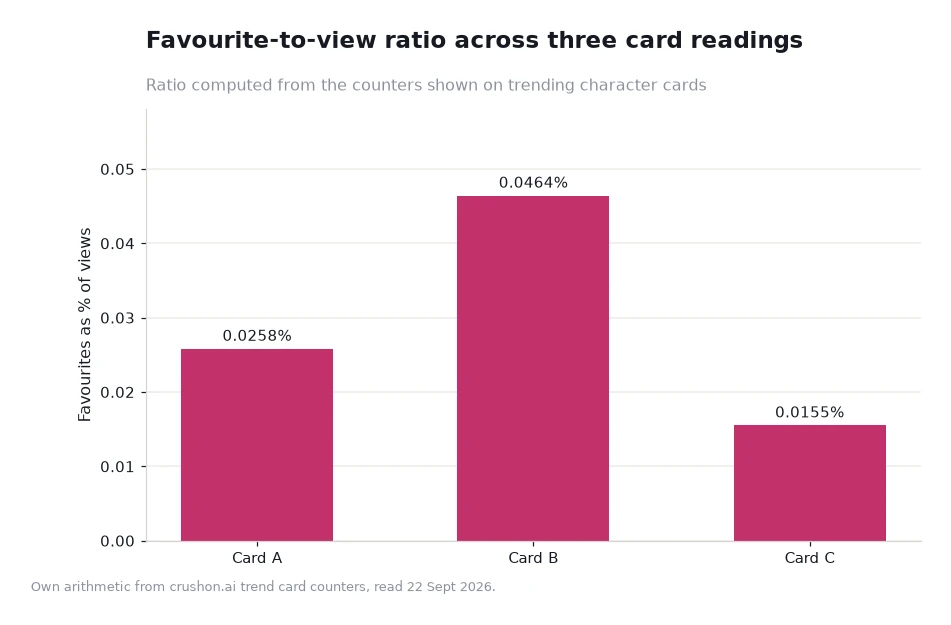
- Repeat use, not volume, is what the counters hint at: keep rates on three card readings ran 0.0258%, 0.0464% and 0.0155%, a threefold spread.
What the word covers, and what it leaves out
Every unlimited claim names a subject, and the subject is usually the platform's own supply: how many messages a character will answer, how many sessions you can open, whether anything is metered by time of day. That is a real commitment, and it is narrower than the word suggests. It says nothing about the three things that actually cap a habit.
The first is your minutes. A conversation is a sequence of messages you read and write, and the reading half is invisible in any plan description. The second is your attention: an unbounded session tends to sprawl, and a session that sprawls is harder to repeat tomorrow. The third is opportunity: the evenings you have available are fixed regardless of what a plan offers.
So the useful response to unlimited is not suspicion but measurement. Work out your current volume in units you control - sessions a week, minutes a session, messages a day - and then ask whether the claim changes any of those numbers. If it does not, the claim is irrelevant to you, which is a perfectly good answer.
Three questions to ask before believing a volume claim
First, is the subject messages or access? Unlimited messaging and unlimited access are different promises with different bottlenecks. A habit of six sessions a week at twelve minutes is 72 minutes a week, and no message allowance changes what those minutes cost you.
Second, what is excluded? Any product of this kind has rules that are not about volume at all, and the FAQ on https://crushon.ai/ai-porn-chat states plainly that some limitations apply in line with the platform's content and community guidelines. Crushon describes the product in that same FAQ as Porn Chat AI, so the sentence about limitations sits beside the description rather than underneath it. Read it as the honest qualifier it is: an unfiltered shelf with published guidelines is not the same as an anything-goes shelf, and an article that blurs the two is selling rather than explaining.
Third, what would you actually use above your baseline? Unlimited only matters at the margin. Suppose your baseline is 540 messages a month. The value of an unlimited offer to you is whatever you would send beyond 540, and if you have never reached 540, the honest marginal value today is zero - which is not an argument against the offer, only a reason to decide after a month of counting rather than before.
| Claim on a plan page | What it covers | The limit it does not remove |
|---|---|---|
| Unlimited messaging | Number of messages a character will answer | Minutes you have to read and write them |
| Unlimited access | Entry to the platform and its shelves at any hour | Attention: an open session still has to be held |
| Priority or faster responses | How quickly replies arrive at busy times | Session length, which grows if replies are quicker |
| "Best deal" style homepage wording | Nothing measurable; it is a call to action | Nothing, which is why it should not drive a decision |
| Guidelines and content limits | What the platform will and will not host | Nothing about volume; it applies to every reader |
Worked example: converting a habit into a comparison
Use the chart arithmetic, because it is the only unit that lets you compare your own behaviour with a claim. Daily messages times 30 days gives 120 at 4 a day, 540 at 18 a day and 1,800 at 60 a day. At 30 seconds of typing per message, those are 60, 270 and 900 minutes a month: one hour, four and a half hours, and fifteen hours.
Now add reading, which is the half people forget when they estimate their own usage. If a session is a third writing and two thirds reading, the 540-message month is closer to 810 minutes - 13.5 hours - and the 1,800-message month is 2,700 minutes, or 45 hours. The second figure is larger than most readers expect, and it is the reason a volume claim should be judged in hours rather than in messages.
Then use the counters for a different question: how much do other readers keep rather than merely open? On the three card readings used here, favourites ran 0.0258%, 0.0464% and 0.0155% of views, a threefold spread. Repeat use shows up as a rate, not a total, and a rate is the better guide to whether something is worth an unlimited relationship. Every figure in this section is an illustrated assumption, not platform data.
Deciding in the right order
Order matters here, because a plan decision made before a usage baseline is a guess. Spend two weeks counting three things: sessions, minutes per session and messages sent. Write them in one line a day. At the end you have a monthly profile in the same units as the chart above, and the comparison becomes arithmetic instead of impression.
Then read the platform's own words rather than a summary of them. The unlimited plan page is the only place where the offer is stated as the platform states it, and this article deliberately quotes no figures from it beyond that fact, because prices and plan names are not part of the data set used here. What the page describes is an offer; what your fortnight of counting describes is a need. Match them in that direction.
Finally, treat the rules as part of the product. An unfiltered adult platform with published content and community guidelines, a content removal policy and a complaints process is describing a bounded service, and the boundaries are the same whether you read fifty messages a week or five hundred. If you want the detail on what the product claims to be, the Crushon AI chat blog covers setup and usage topics in the same plain terms, which makes it a better companion to a plan decision than the marketing line at the top of a page.
Frequently asked questions
Does unlimited mean there are no rules at all?
No. The platform's FAQ says some limitations apply in accordance with its content and community guidelines, and those limits sit alongside any volume offer rather than being replaced by it.
How many messages a month does a habit actually produce?
Daily messages times 30 days: 120 at 4 a day, 540 at 18 a day and 1,800 at 60 a day. Reading time usually adds more to the total than writing does.
When should I read a plan claim carefully?
Once your own usage reaches the point where a limit would bind. Below that, measure first: two weeks of counting one line a day gives a baseline that makes the claim comparable.
Measure, then read the offer
Write down a session count, a typical length in minutes and a messages-per-day figure for the next fourteen days. Then open the offer page and check each claim against those three numbers, ignoring anything you cannot measure - especially headline wording with no figure attached. If the offer removes a limit you never reach, the right decision is to change nothing and revisit it after another month of counting.
Data: card counters and the platform's FAQ wording about guidelines, read 22 Sept 2026[1]. Message and time figures are own arithmetic shown as an illustrative profile rather than platform data, and no price or plan name is quoted in this article. Intended for adult readers; the service is for those aged 18 and over.